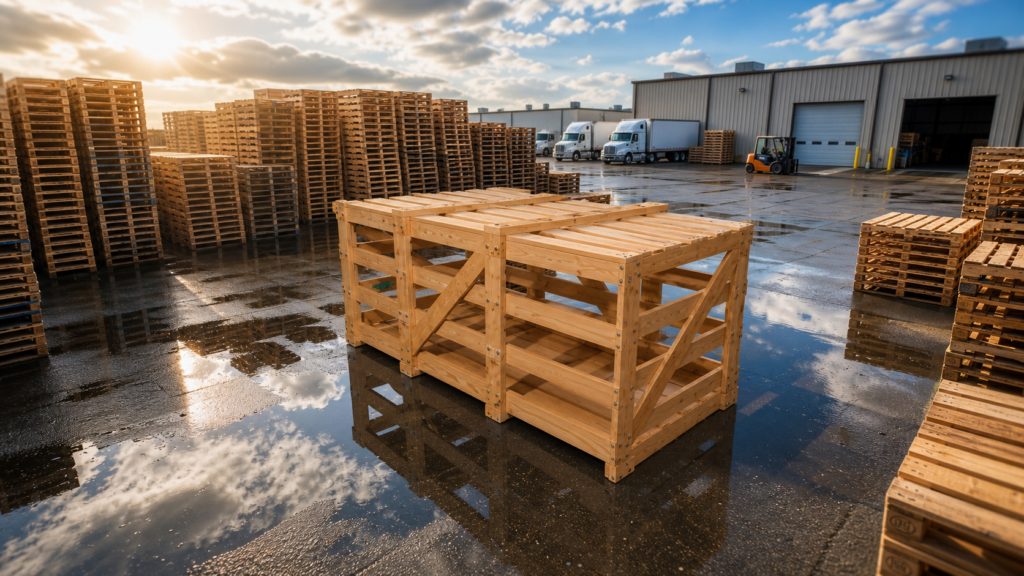
Choosing the right wooden crates is one of the most important decisions when products need extra protection during storage, transportation, or export. Unlike pallets that mainly support products from underneath, wooden crates surround and stabilize valuable equipment, delicate items, and oversized cargo to help reduce movement during handling and transportation.
You’ll find how different crate designs are used, the situations where they provide the greatest value, and the key factors to evaluate before choosing a solution for your shipment.
At a Glance
| Best For | Machinery, fragile equipment, export shipments, industrial products |
|---|---|
| Primary Purpose | Protect products during storage and transportation |
| Available Options | Open, closed, slatted, plywood, and custom-built crates |
| Export Ready? | Yes, when manufactured as heat treated wooden crates and compliant with ISPM 15 |
| Can They Be Customized? | Yes, dimensions, strength, and construction can be tailored to specific products |
| Typical Industries | Manufacturing, aerospace, automotive, construction, energy, food processing, and logistics |
What Are Wooden Crates?
A pallet isn’t always enough to protect every type of shipment. Heavy machinery, delicate equipment, and high-value goods often need protection from all sides to reduce the risk of impact, shifting, or damage during handling. That’s where wooden crates become the better solution.
A wooden crate is a protective wood packaging structure built around a product instead of simply supporting it from underneath. Depending on the item being shipped, crates can be fully enclosed, partially enclosed, or open-frame designs that provide the right balance of strength, accessibility, and protection.
Unlike standard pallets, wooden box crates help secure the load during transportation while shielding it from external contact. Businesses commonly choose wooden crates for machinery, export cargo, delicate equipment, and oversized products where secure handling and product stability are essential.
What Makes a Wooden Crate Different?
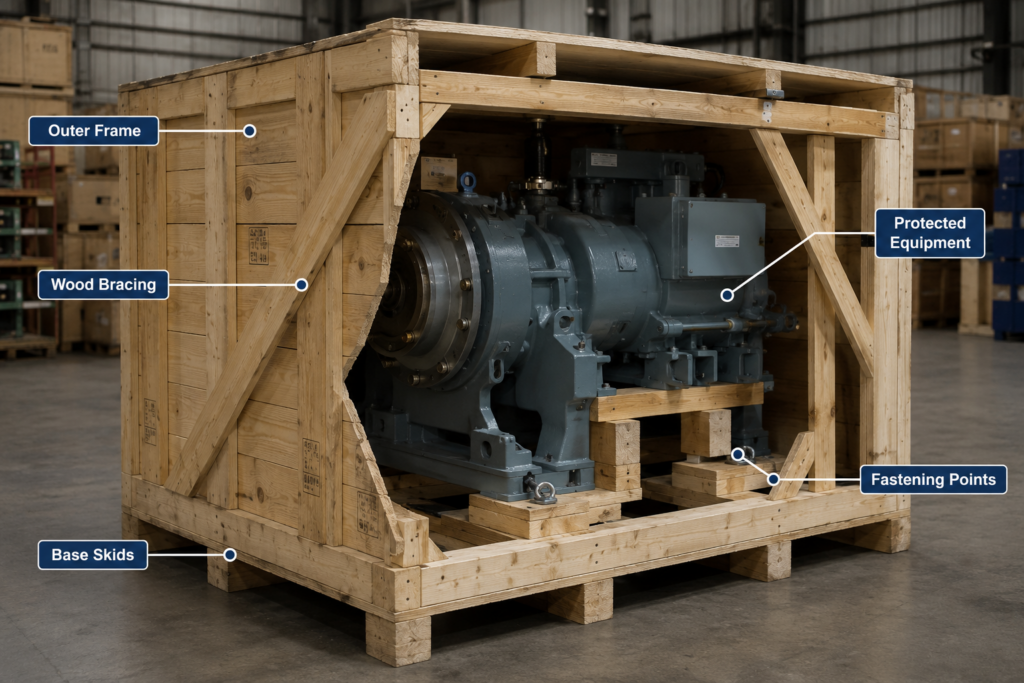
A well-designed crate does more than hold a product—it is built around the way that product will be lifted, transported, stored, and delivered. The design can be adjusted to match the item’s size, weight, lifting points, and destination, making custom wooden crates a practical choice when standard packaging isn’t enough.
Wooden Crates or Pallets: Which One Should You Choose?
Wooden crates and pallets both play an important role in product transportation, but they’re built for different packaging needs. Selecting the right option comes down to the characteristics of the product, the way it will be handled, and the amount of protection needed throughout its journey.
In general, wooden pallets are designed to support a load from underneath, while crates are designed to protect it from multiple sides. That’s why products like industrial machinery, delicate equipment, and export goods are often shipped in crates rather than placed directly on a pallet.
Quick Decision Guide
| If you need to… | Better Choice |
|---|---|
| Move boxed products around a warehouse | Wooden pallet |
| Protect fragile or high-value equipment | Wooden crate |
| Ship oversized machinery | Wooden crate |
| Store palletized inventory | Wooden pallet |
| Export products that need extra protection | Heat-treated wooden crate |
| Reduce movement during transport | Wooden crate |
Think About the Product—Not the Packaging
Instead of choosing packaging first, start with the product you’re shipping.
For example, a pallet may be the right solution for stacked cartons or packaged inventory that only needs a stable base. However, if the product has exposed parts, delicate surfaces, or an irregular shape, a wooden crate provides the added support needed to reduce movement and help prevent damage throughout the journey.
This is why many manufacturers use pallets for routine warehouse handling but choose wooden packing crates when preparing valuable equipment for long-distance transportation or export.
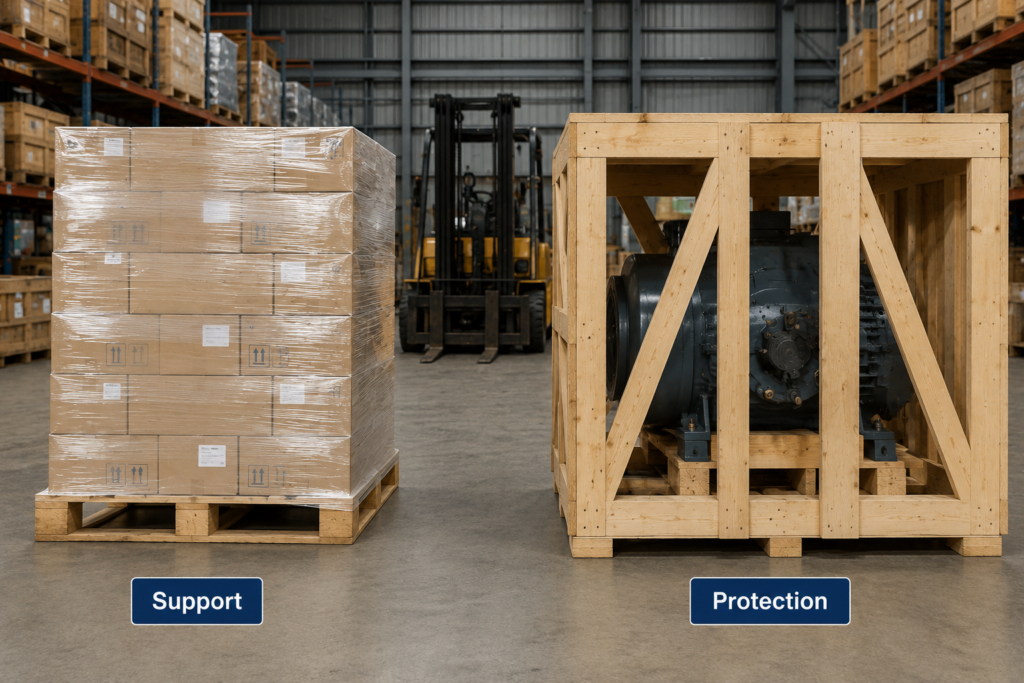
Pro Tip: Some shipments use both. Heavy machinery is often secured to a custom pallet first and then enclosed inside a wooden crate for additional protection. This combination improves stability during lifting while helping protect the equipment during transport.
Which Type of Wooden Crate Is Right for Your Products?
Different shipping requirements call for different crate designs. The right design depends on what you’re shipping, how the product will be handled, and the level of protection required during storage or transportation.
Instead of selecting a crate based only on its appearance, choose one that matches your product’s dimensions, weight, shipping method, and handling requirements.
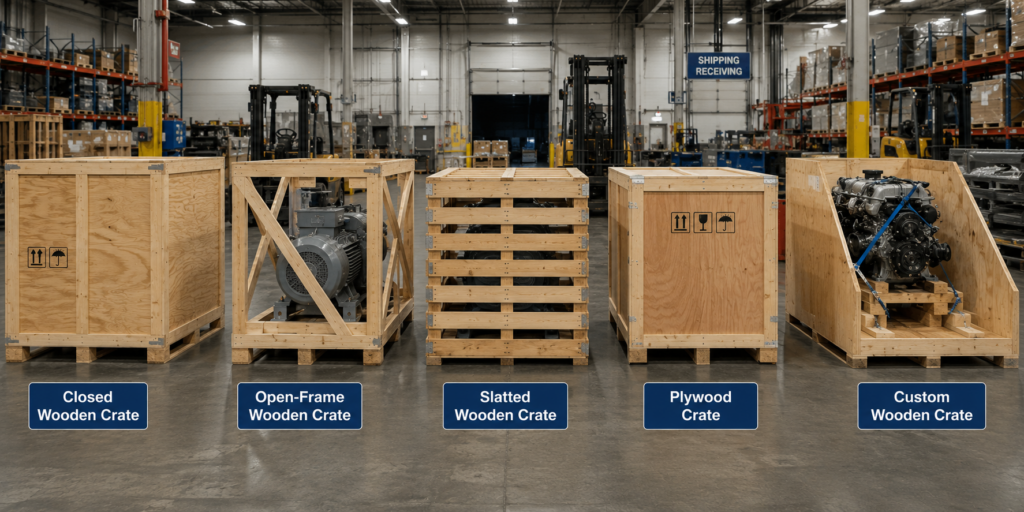
Wooden Crate Selection Guide
| Crate Type | Best For | Protection Level |
|---|---|---|
| Closed Wooden Crate | Fragile equipment, electronics, export shipments | High |
| Open-Frame Wooden Crate | Heavy machinery, oversized equipment | High |
| Slatted Wooden Crate | Products that require ventilation or visual inspection | Medium |
| Plywood Crate | Lightweight freight, air shipments, export packaging | High |
| Custom Wooden Crates | Products with unique dimensions or handling needs | Depends on the design |
Closed Wooden Crates
A closed wooden crate fully surrounds the product, providing protection from accidental impact, dust, and handling damage. It’s commonly used for export shipments, sensitive equipment, and products that need to remain protected throughout transportation and storage.
Open-Frame Wooden Crates
An open-frame wooden crate protects large or heavy products while leaving key lifting and inspection points accessible. This design is ideal for industrial machinery and oversized equipment that doesn’t require a fully enclosed structure.
Slatted Wooden Crates
Slatted wooden crates are built with spaced timber boards that allow airflow and make visual inspections easier. They are often chosen for products that need moderate protection while keeping the overall crate lighter than a fully enclosed design.
Plywood Crates
A plywood crate combines a solid timber frame with plywood panels to create a lightweight yet durable packaging solution. This type is frequently used when reducing shipping weight is important without compromising product protection.
Custom Wooden Crates
When standard crate sizes aren’t suitable, custom wooden crates are built around the product itself. Dimensions, internal supports, fastening points, and overall construction can all be tailored to improve protection, handling, and transportation efficiency.
Expert Recommendation: The best crate isn’t necessarily the largest or the strongest. A well-designed crate should match the product’s weight, shape, handling method, and shipping route. Choosing a design based on actual transportation requirements often provides better protection while avoiding unnecessary material and freight costs.
When Are Wooden Crates the Best Choice?
A pallet is often enough for products that are already boxed, wrapped, or securely packaged. However, when a shipment is vulnerable to impact, movement, or rough handling, wooden crates provide an additional level of protection that a pallet alone cannot.
The right choice depends less on the industry and more on the product itself. If damage during transportation could result in costly repairs, delays, or product replacement, investing in the right crate is often the more practical decision.
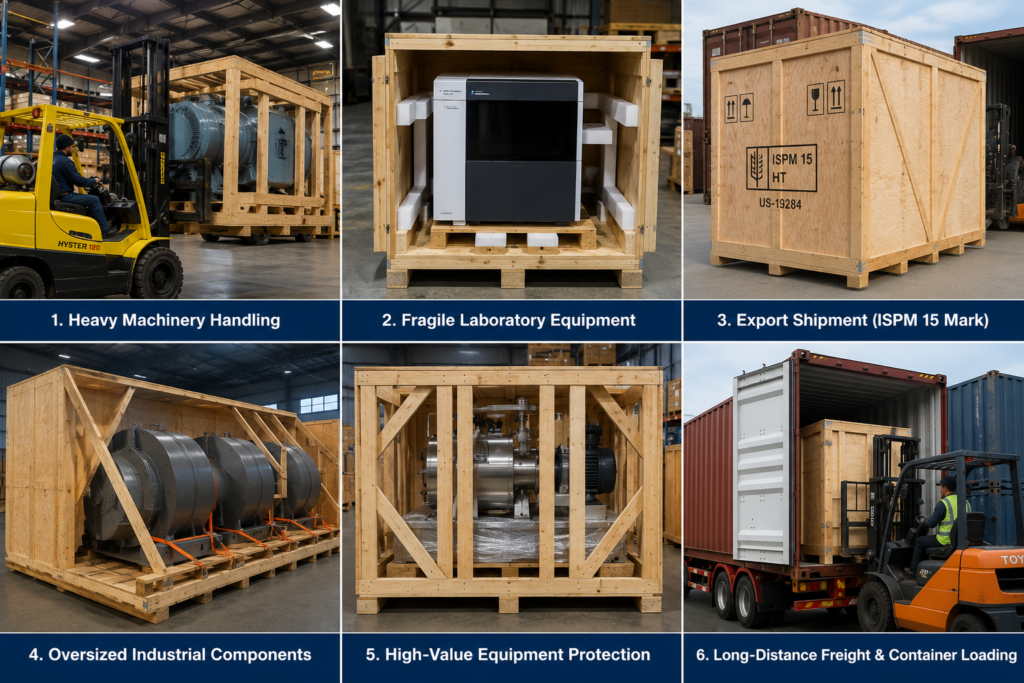
Common Situations Where Crates Make Sense
| Shipping Situation | Why a Wooden Crate Is the Better Choice |
|---|---|
| Heavy industrial machinery | Supports the load while protecting exposed components during handling and transport. |
| Fragile or precision equipment | Reduces movement and allows internal blocking to protect delicate parts. |
| International export shipments | Can be manufactured as heat treated wooden crates to meet ISPM 15 import requirements. |
| Long-distance freight | Provides greater stability when products pass through multiple handling points. |
| Oversized or irregular products | Can be custom-built around the product instead of forcing it into standard packaging. |
| High-value shipments | Helps lower the risk of accidental impact, shifting, and handling damage. |
It’s About Risk, Not Just Protection
One of the biggest misconceptions is that every shipment needs a crate. In reality, the decision should be based on the level of risk involved.
For example, boxed consumer goods stored on warehouse racks may only require a pallet. On the other hand, equipment with exposed controls, sensitive surfaces, or complex components benefits from the added protection that wooden box crates provide throughout transportation.
Think Beyond the Journey
A well-designed crate isn’t only built for shipping. It should also support safe lifting, temporary storage, unloading at the destination, and, in some cases, long-term protection before installation or use. Planning for the entire logistics process often results in better packaging decisions and fewer handling issues.
Professional Insight: Many businesses focus on the cost of the crate itself, but the real comparison is between the cost of packaging and the potential cost of product damage, shipping delays, insurance claims, or replacement. Choosing the right crate is often a risk management decision rather than simply a packaging decision.
Do Wooden Crates Need Heat Treatment for Export?
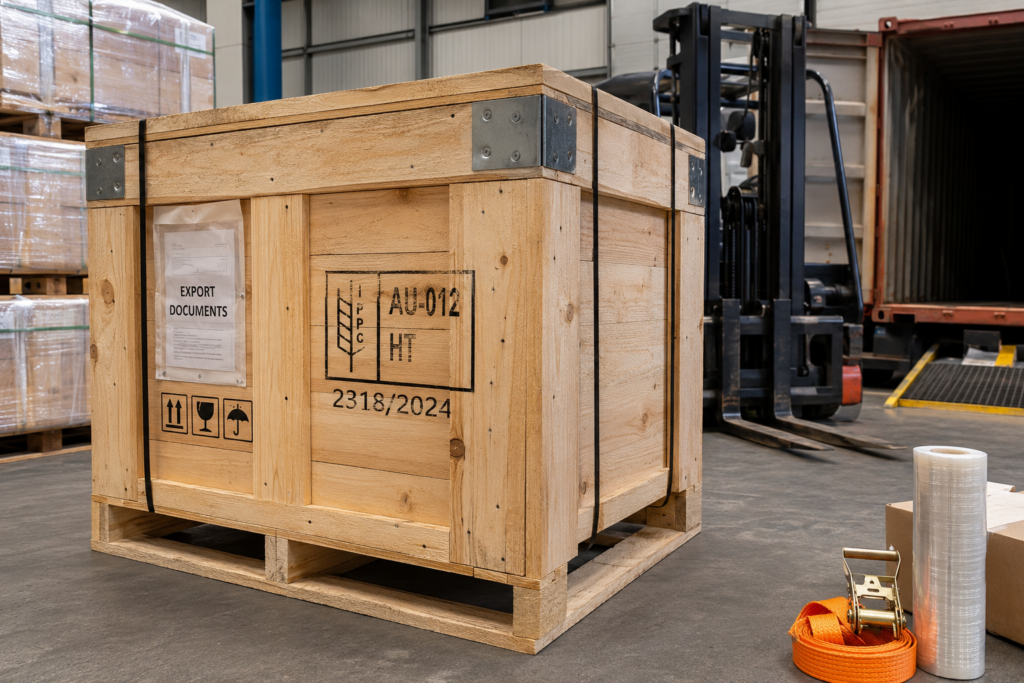
If wooden crates are being used for international shipping, the answer is often yes. Many countries require solid wood packaging to comply with ISPM 15, an international standard that helps prevent the spread of pests and wood-borne insects through global trade.
To meet these requirements, the lumber used to manufacture the crate is heat treated before use. Once the treatment process is completed and verified, the crate receives the appropriate IPPC/ISPM 15 marking, allowing it to be used for export to countries that recognize the standard.
It’s important to remember that these requirements generally apply to solid wood packaging. Packaging materials such as plywood, OSB, or other engineered wood products may be treated differently under ISPM 15 regulations, depending on the material and destination country’s import rules.
When Is Heat Treatment Required?
Heat-treated wooden crates are commonly required when shipping:
- Industrial machinery
- Manufacturing equipment
- Automotive components
- Commercial products for overseas customers
- Large equipment packed in solid wood packaging
If your shipment will cross international borders, it’s a good idea to confirm the destination country’s import requirements before manufacturing the crate.
Heat Treatment Doesn’t Make a Crate Stronger
A frequent misconception is that the heat-treatment process makes a wooden crate stronger, but that’s not its purpose.
It doesn’t.
The purpose of heat treatment is regulatory compliance, not structural performance. A heat-treated crate protects products the same way as a non-treated crate, the difference is that it meets the phytosanitary requirements needed for international trade.
How Much Weight Can a Wooden Crate Hold?
There isn’t a single weight limit for all wooden crates. The load capacity depends on several factors, including the crate’s dimensions, the type of lumber used, the internal support structure, and how the weight is distributed across the base.
A crate built for lightweight electronic equipment may only need minimal reinforcement, while one designed for industrial machinery can be engineered to safely support several tonnes. That’s why commercial crates are designed around the product instead of following a one-size-fits-all specification.
What Determines a Crate’s Load Capacity?
When designing a crate, manufacturers typically evaluate these factors before deciding on the construction.
| Factor | Why It Matters |
|---|---|
| Product weight | Determines the strength required for the base and frame. |
| Weight distribution | Evenly distributed loads place less stress on the crate than concentrated loads. |
| Crate dimensions | Larger crates often require additional reinforcement to maintain stability. |
| Timber specification | Different lumber grades and sizes provide different structural performance. |
| Internal bracing | Helps prevent movement and supports the product during transportation. |
| Handling method | Forklifts, cranes, and lifting points influence the crate’s design. |
A Proper Fit Is More Important Than Maximum Strength
Many people assume the strongest crate is automatically the safest choice. In reality, an oversized or overbuilt crate can increase material costs, shipping weight, and handling complexity without providing any additional benefit.
The best wooden crate is one that’s engineered to match the product it will carry. A correctly sized crate with appropriate internal support often performs better than a heavier crate built without considering the shipment’s actual requirements.
Planning for Dynamic Loads
A crate doesn’t only support weight while it’s sitting still. During loading, unloading, road transport, and container shipping, the product may experience vibration, sudden stops, or repeated movement.
For that reason, commercial wooden box crates are designed to withstand both the product’s weight and the forces it may experience throughout the shipping process.
How to Choose the Right Wooden Crate
Selecting the right wooden crate starts with understanding the product rather than the packaging. A crate that works well for one shipment may not be suitable for another, even if the products are similar in size. Considering a few practical factors before manufacturing or ordering a crate helps improve protection, handling efficiency, and shipping performance.
Start with the Product
Before choosing a crate, gather the essential information about what you’re shipping.
| Consider | Why It’s Important |
|---|---|
| Product dimensions | Ensures the crate fits without leaving excessive empty space. |
| Total weight | Determines the required strength of the base and frame. |
| Fragility | Identifies whether additional internal support or cushioning is needed. |
| Centre of gravity | Helps create a balanced design for safe lifting and transport. |
| Lifting method | The crate should suit forklifts, cranes, or other handling equipment. |
Think About the Entire Shipping Journey
A shipment doesn’t move in a single step. It may be loaded onto a truck, transferred through distribution centres, stored in a warehouse, loaded into a shipping container, and finally unloaded at its destination.
Each stage places different demands on the packaging. Choosing a wooden crate that matches the complete transportation process helps reduce unnecessary handling risks along the way.
Don’t Pay for Protection You Don’t Need
It’s easy to assume that a larger or heavier crate offers better protection. In reality, extra material can increase freight costs and make handling more difficult without improving safety.
The most effective crate is one that’s designed around the product’s actual shipping requirements rather than built to a standard size.
When a Standard Crate Isn’t Enough
Products with unusual dimensions, uneven weight distribution, or sensitive components often require a custom-built solution instead of an off-the-shelf crate.
A crate designed specifically for the product usually provides a better fit, improved stability, and more efficient handling throughout transportation.
Decision Checklist
Before ordering wooden crates, make sure you can answer these questions:
- What are the exact dimensions of the product?
- How much does the shipment weigh?
- Will it be stored, transported, or exported?
- What handling equipment will be used?
- Does the product need full enclosure or partial protection?
- Is a standard crate suitable, or would a custom design provide a better fit?
Can Wooden Crates Be Customized?
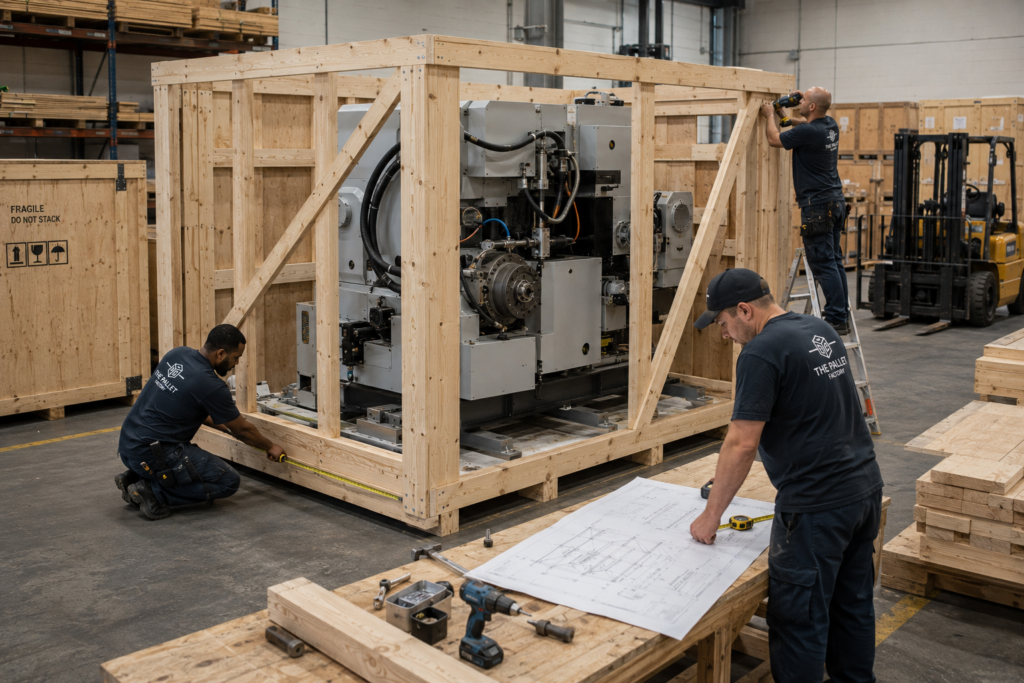
Standard wooden crates work well for many products, but they aren’t the best solution for every shipment. Machinery, fabricated metal parts, electrical equipment, and oversized products often require packaging that’s built around the item instead of forcing the item to fit a standard crate.
Custom-built crates allow the packaging to match the product’s exact dimensions, handling requirements, and transportation conditions. This improves protection while making loading, unloading, and storage more efficient.
What Can Be Customized?
Depending on the application, manufacturers can adjust different parts of the crate to suit the shipment.
| Custom Feature | Why It’s Customized |
|---|---|
| Dimensions | To match the product and reduce empty space |
| Internal bracing | To keep the product stable during transport |
| Base design | To suit forklifts, pallet jacks, or crane lifting |
| Timber thickness | To support different load requirements |
| Open or enclosed construction | To balance protection, accessibility, and shipping needs |
| Export compliance | To meet international shipping requirements when necessary |
When Does a Custom Crate Make More Sense?
A custom-built crate is often the better option when:
- The product doesn’t fit standard crate sizes.
- The shipment contains expensive or delicate equipment.
- The load has an uneven weight distribution.
- The product will be exported internationally.
- Special lifting or handling points are required.
Rather than adapting the product to the packaging, the packaging is designed to fit the product safely and efficiently.
A Better Fit Often Reduces Overall Costs
While a custom crate may require more planning, it can reduce unnecessary packaging material, improve space utilization during transport, and lower the risk of product damage. For many industrial shipments, that makes a custom solution more cost-effective over the long term than modifying a standard crate.
If your shipment requires packaging built around specific dimensions, weight, or handling requirements, our custom pallets and wood packaging solutions can be designed to match your exact application.
Final Thoughts
The right wooden crates do more than package a product, they help protect it throughout storage, handling, and transportation. Whether you’re shipping delicate equipment, heavy machinery, or export cargo, choosing a crate that matches the product’s requirements can reduce handling risks and improve overall logistics efficiency.
Rather than focusing only on crate size or construction, consider the entire journey your product will take. Factors such as weight, lifting methods, transportation conditions, and destination all play an important role in selecting the right packaging solution.
For products that require a non-standard design, custom pallets and custom-built wooden crates provide a practical way to improve protection, handling, and shipping performance while meeting your specific operational requirements.
Need a Packaging Solution?
Every shipment has different packaging requirements, and the right solution depends on factors such as product size, weight, handling methods, and shipping destination. If you’re unsure which type of wooden crate or wood packaging is best for your application, you can learn more about our approach to manufacturing or get in touch with our team to discuss your project and packaging requirements.