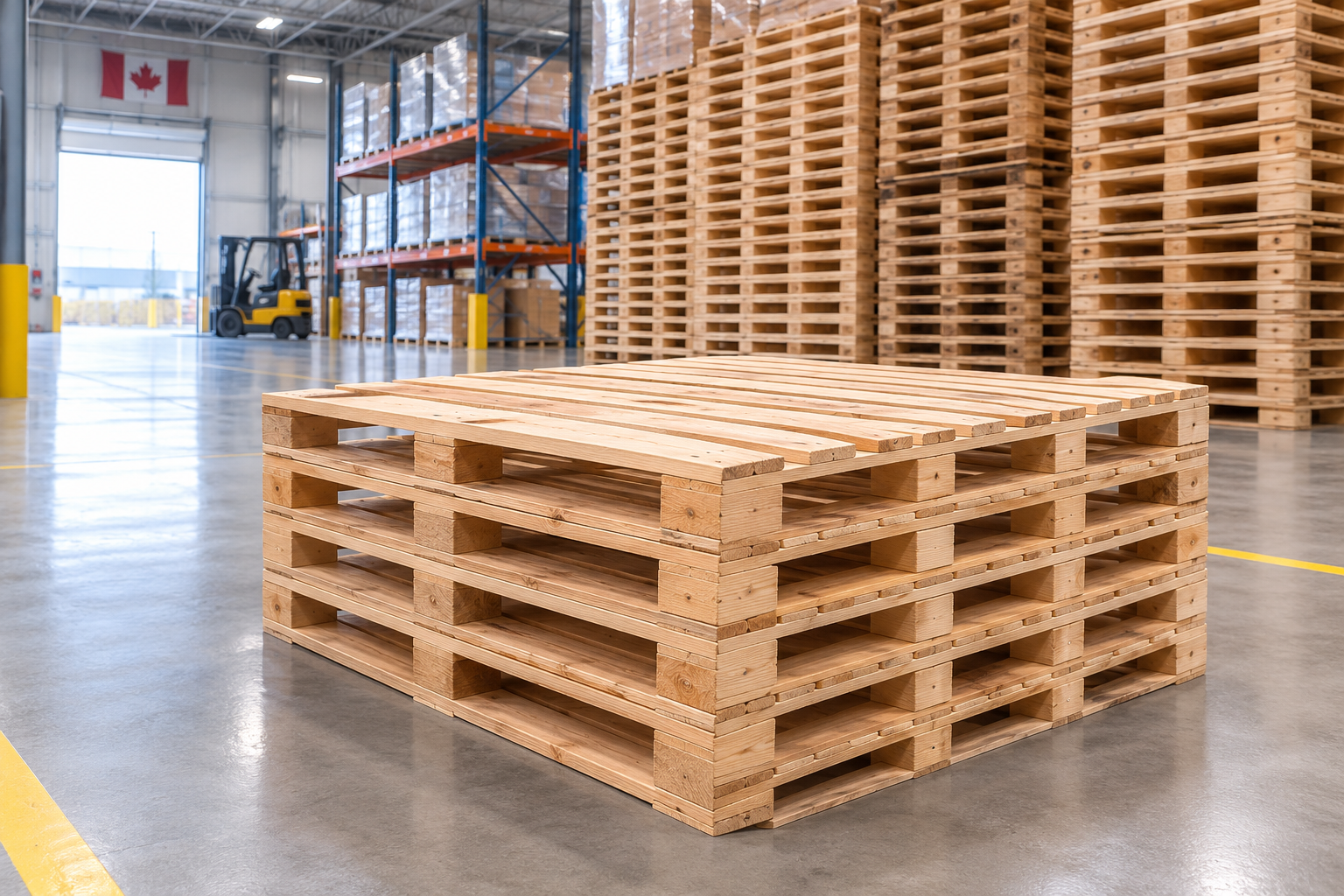
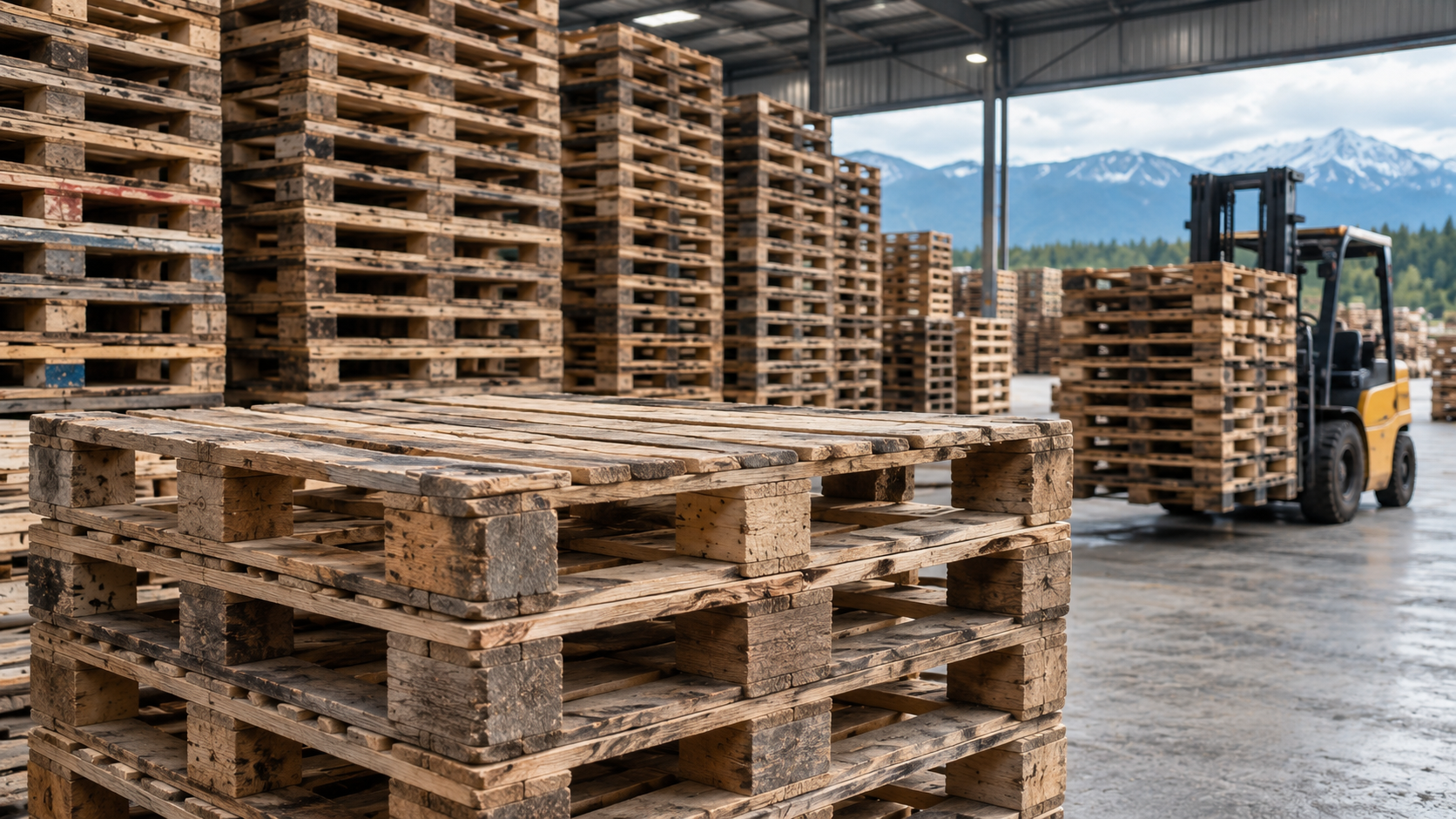
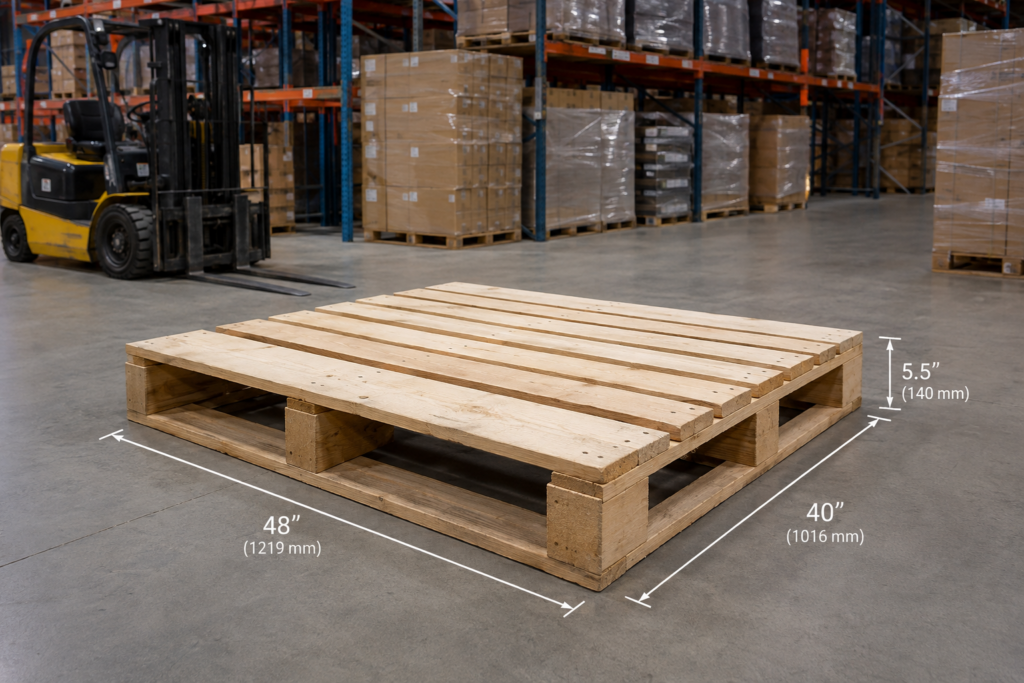
Every standard pallet size used across Canada serves a purpose, but the 48 × 40-inch (1219 × 1016 mm) pallet has become the industry benchmark because it balances storage efficiency, transportation, warehouse handling, and product stability. While it’s the most common pallet you’ll encounter, it’s not automatically the right choice for every business.
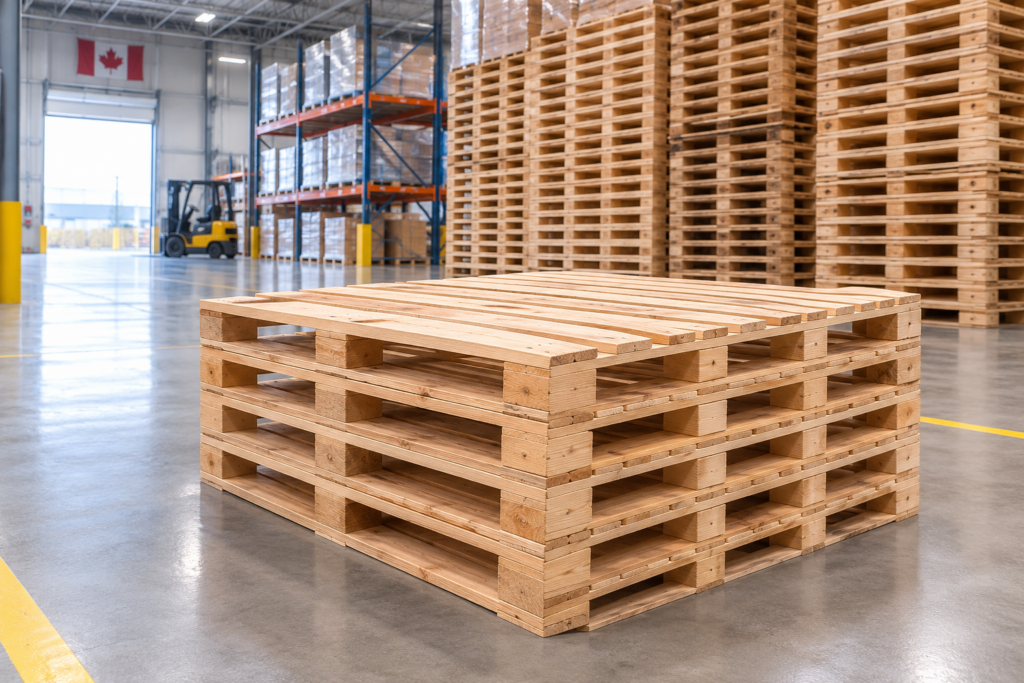
Understanding standard pallet dimensions goes beyond knowing the measurements. The size of a pallet affects warehouse racking, trailer capacity, forklift handling, shipping costs, and even whether your products travel safely from one destination to another. Choosing the right pallet starts with understanding how your operation works, not simply selecting the most common size.
What Is the Standard Pallet Size in Canada?
If someone asks for a standard pallet size, they’re almost always referring to the 48 × 40-inch wooden pallet, commonly known as the GMA (Grocery Manufacturers Association) pallet. It has become the preferred size across Canada and North America because it works efficiently with warehouse racking systems, forklifts, trailers, and most commercial distribution networks.
Rather than being an arbitrary measurement, this pallet size was adopted because it simplifies material handling throughout the supply chain. From manufacturers and distribution centres to retailers and logistics providers, using a common pallet size reduces handling delays, improves trailer utilisation, and creates greater consistency across warehouse operations.
Standard Pallet Specifications at a Glance
| Specification | Standard Value |
|---|---|
| Standard pallet size | 48 × 40 inches |
| Metric dimensions | 1219 × 1016 mm |
| Common name | GMA Pallet |
| Material | Wooden pallets (hardwood or softwood) |
| Entry type | Two-way or four-way (depending on design) |
| Typical applications | Manufacturing, warehousing, retail, logistics, distribution |
Warehouse Insight: The 48×40 pallet didn’t become the industry standard simply because of its dimensions, it became the standard because warehouses, forklifts, pallet racking, and transportation equipment have evolved around it. Choosing a different size without a clear operational reason can reduce storage efficiency and increase handling costs.
Why This Size Became the Industry Standard
A warehouse storing thousands of pallet loads every month depends on consistency. When pallets share the same footprint, businesses can plan racking layouts more efficiently, maximise trailer space, and reduce unnecessary product movement during loading and unloading.
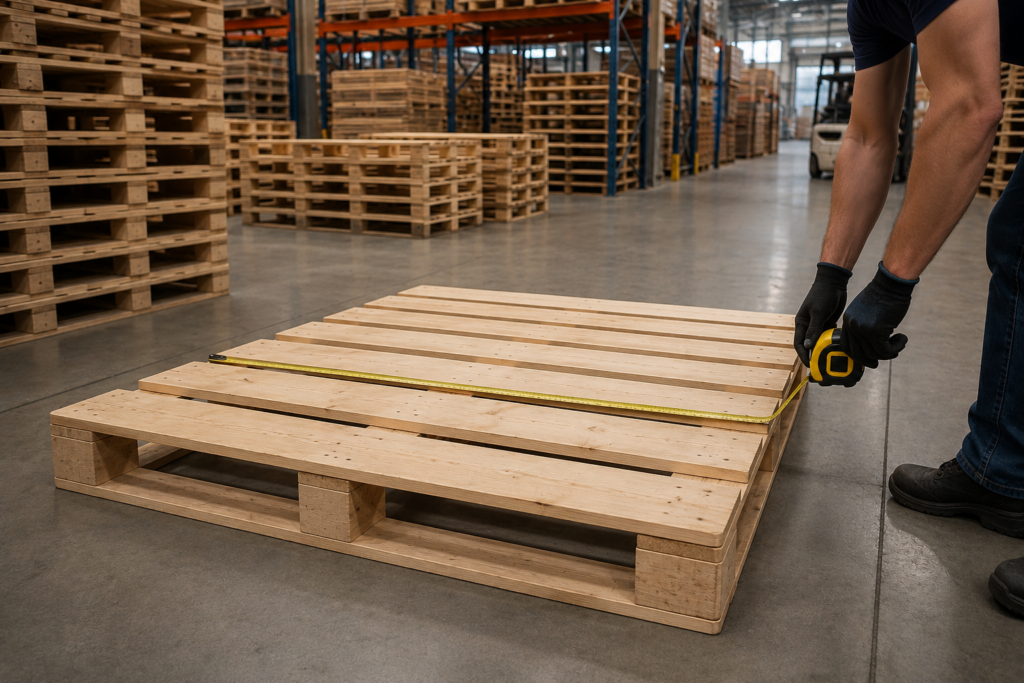
This is why you’ll find standard pallet sizes used across industries including:
- Retail distribution
- Manufacturing
- Food and beverage
- Consumer goods
- Third-party logistics (3PL)
- Wholesale distribution
However, not every shipment fits a standard footprint. Products with unusual dimensions, oversized equipment, or specialised handling requirements often perform better on custom pallets designed around the load rather than forcing the load to fit the pallet.
Standard Pallet Dimensions & Specifications: More Than Just 48 × 40 Inches
Knowing the standard pallet size is useful, but the dimensions alone don’t tell the full story. A pallet’s performance also depends on its construction, deck layout, entry design, and the materials used to build it. These details determine how well a pallet performs in storage, transportation, and everyday warehouse handling.
While specifications may vary slightly depending on the manufacturer and intended application, the standard pallet specifications used across Canada generally follow the widely adopted 48 × 40-inch GMA footprint.
Standard Pallet Specifications
| Specification | Typical Standard |
|---|---|
| Standard pallet dimensions | 48 × 40 in. (1219 × 1016 mm) |
| Overall height | Approximately 5.5–6.5 in. (varies by design) |
| Entry type | Two-way or four-way |
| Construction | Stringer pallets or block pallets |
| Material | Hardwood or softwood |
| Common applications | Warehousing, manufacturing, retail, logistics, distribution |
Expert Note: There isn’t a single universal specification that applies to every pallet. Board thickness, number of deck boards, fasteners, and lumber species can all vary depending on the pallet’s intended use. That’s why businesses should evaluate the complete pallet design rather than relying on dimensions alone.
Why Standard Dimensions Matter Throughout the Supply Chain
A standard pallet isn’t simply easier to stack, it creates consistency throughout an entire logistics network.
Using common standard pallet measurements allows businesses to:
- Maximise warehouse storage space.
- Improve forklift accessibility.
- Reduce product overhang.
- Increase trailer utilisation.
- Simplify inventory handling.
- Improve compatibility with pallet racking systems.
- Reduce handling delays during loading and unloading.
When every pallet entering a warehouse follows the same footprint, operations become more predictable and efficient.
Industry Example: A distribution centre receiving products from multiple suppliers can unload, store, and dispatch inventory much more efficiently when shipments arrive on standard-sized pallets. Consistent dimensions reduce unnecessary product transfers and minimise handling time between receiving and shipping.
Standard Pallet Sizes Used Across Different Industries
Although the 48 × 40-inch pallet is the most widely used standard pallet size in Canada, it’s not the only size found across commercial supply chains. Different industries often adopt alternative pallet footprints based on product dimensions, storage methods, and transportation requirements.
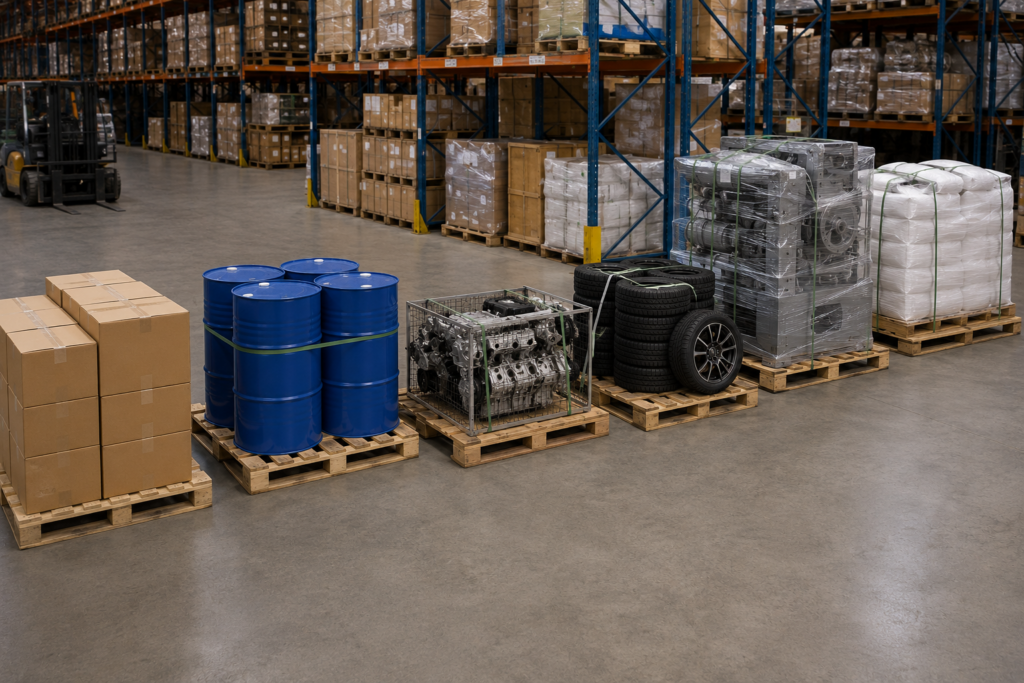
Understanding these variations helps businesses choose pallets that better match their operational needs rather than assuming one size fits every application.
| Industry | Common Pallet Size | Typical Application |
|---|---|---|
| Grocery & Retail | 48 × 40 in. | Consumer goods, packaged products |
| Beverage & Chemicals | 48 × 48 in. | Drums, bulk liquid containers |
| Automotive | 48 × 45 in. | Automotive parts and components |
| Telecommunications & Paint | 42 × 42 in. | Heavy equipment and specialised products |
| Dairy & Food Processing | 40 × 40 in. | Dairy crates and food distribution |
Warehouse Insight: Choosing a pallet simply because it’s the industry standard can sometimes create unnecessary product overhang or wasted warehouse space. The best pallet size is the one that supports your products safely while working efficiently with your storage, handling equipment, and transportation network.
When a Standard Pallet Isn’t the Best Fit
Standardisation improves efficiency, but it isn’t always the best solution.
Businesses often benefit from a non-standard pallet when they handle:
- Long or oversized products.
- Heavy machinery or equipment.
- Large fabricated components.
- Irregular product shapes.
- Export products requiring specific packaging dimensions.
- Automated production lines with unique handling requirements.
In these situations, investing in custom pallets can improve load stability, reduce product damage, and make better use of available warehouse and trailer space.
Block Pallets vs. Stringer Pallets: Which Design Is Right for Your Operation?
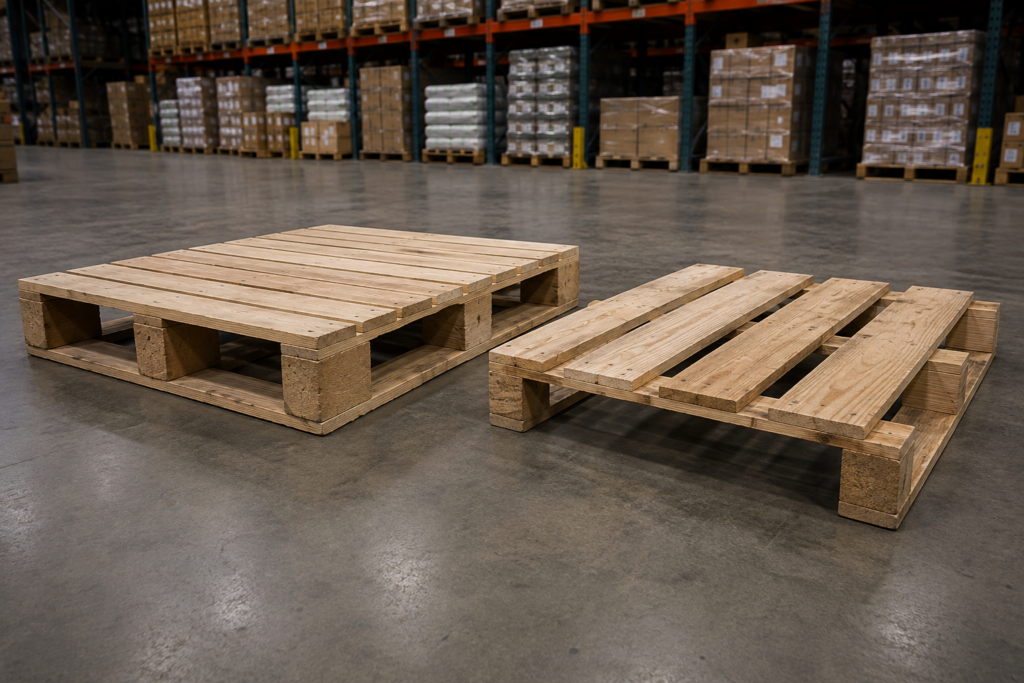
The standard pallet size tells you the footprint of a pallet, but it doesn’t tell you how it’s built. Two pallets can share the same standard pallet dimensions while performing very differently depending on their construction.
The two most common pallet designs used across Canada are stringer pallets and block pallets. Understanding the difference helps businesses choose a pallet that matches their handling equipment, storage systems, and load requirements, not just their budget.
Stringer Pallets: The Industry Workhorse
Stringer pallets are built using longitudinal support boards (known as stringers) that run the length of the pallet. This design has been widely used for decades because it offers a practical balance of strength, availability, and cost for many commercial applications.
They’re commonly used for:
- Retail distribution
- Manufacturing
- Warehousing
- Domestic freight
- General inventory storage
For many businesses, stringer pallets provide dependable performance without the added cost of a more specialised design.
Block Pallets: Built for Greater Accessibility
Unlike stringer designs, block pallets use solid support blocks between the top and bottom deck boards. This allows true four-way forklift and pallet jack entry, making them easier to handle in busy warehouses and automated material handling systems.
Businesses often choose block pallets when they require:
- Faster material movement
- Improved handling from all four sides
- Greater stability for demanding operations
- Better compatibility with automated warehouse equipment
Rather than replacing stringer pallets, block pallets simply serve different operational needs.
Quick Comparison
| Feature | Stringer Pallets | Block Pallets |
|---|---|---|
| Forklift access | Partial four-way or two-way | True four-way access |
| Construction | Longitudinal stringers | Solid support blocks |
| Common applications | Warehousing, retail, manufacturing | High-volume logistics, export, automation |
| Cost | Generally more economical | Typically higher investment |
| Best for | Everyday commercial operations | Operations requiring greater handling efficiency |
Warehouse Insight: Choosing between block and stringer pallets isn’t about selecting the “better” design, it’s about selecting the design that best fits your workflow. A warehouse relying on automated conveyors may benefit from block pallets, while a manufacturer moving products internally may find stringer pallets perfectly suited to daily operations.
Will a Standard Pallet Fit Your Warehouse and Shipping Requirements?
A standard pallet size works well because much of North America’s logistics infrastructure has been designed around it. However, choosing a pallet isn’t just about matching dimensions, it also means ensuring compatibility with your warehouse layout, handling equipment, and transportation methods.
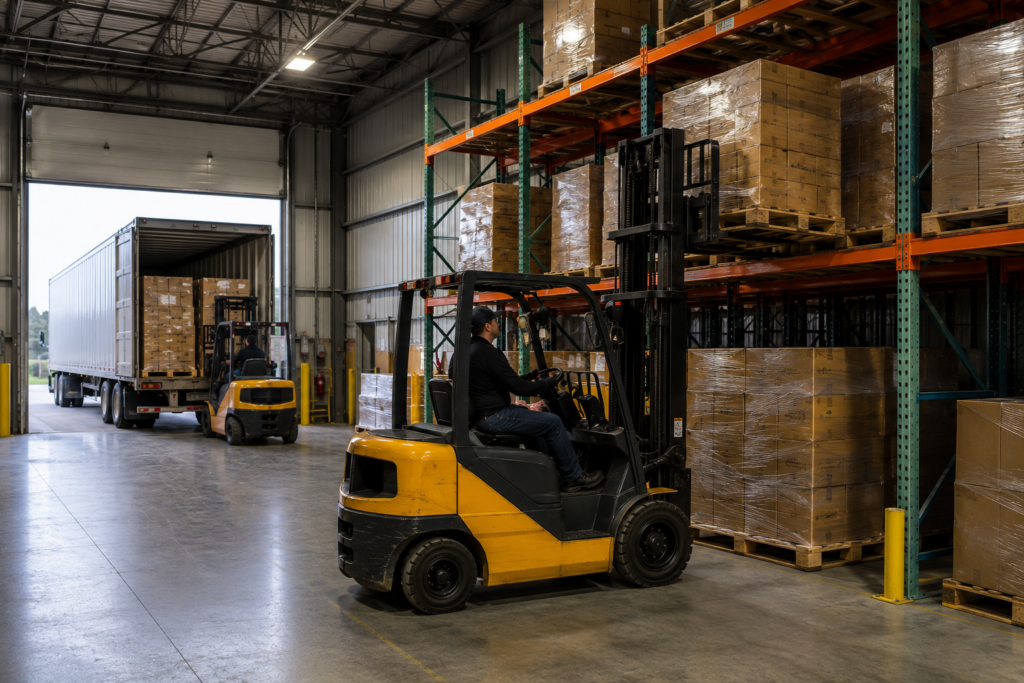
Before ordering pallets, it’s worth evaluating how they’ll move through your operation from receiving to final delivery.
Warehouse Racking Compatibility
Most commercial racking systems are designed to accommodate standard pallet dimensions, allowing businesses to maximise storage while maintaining safe load spacing.
Before selecting a pallet, consider:
- Beam spacing within pallet racking
- Product overhang
- Load distribution
- Available aisle width
- Safe retrieval using forklifts
Even small dimensional differences can affect storage efficiency over hundreds or thousands of pallet positions.
Forklift and Material Handling
Forklifts and pallet jacks operate most efficiently when pallet dimensions remain consistent throughout the warehouse. Uniform pallet sizes improve handling speed, reduce repositioning, and help minimise accidental pallet damage.
Businesses using automated handling systems should also consider pallet consistency, deck condition, and overall build quality when selecting pallets.
Making Better Use of Trailer Space
Pallet size directly affects transportation efficiency. Consistent pallet footprints make it easier to organise loads, reduce wasted trailer space, and improve shipment planning.
Rather than forcing oversized products onto a standard pallet, many businesses evaluate whether an alternative pallet size, or a custom design, can improve product protection while making better use of available trailer capacity.
Expert Recommendation: When reviewing pallet requirements, think beyond today’s shipment. The right pallet should work just as efficiently in storage, during transport, at your customer’s facility, and throughout repeated handling cycles.
Exporting Products? Standard Pallet Size Isn’t the Only Requirement
Using the correct standard pallet size is an important first step for international shipping, but pallet dimensions alone don’t determine whether a shipment can cross international borders. For most countries outside the United States, the wooden pallet itself must also comply with international phytosanitary regulations.
This is where many businesses get caught off guard. A pallet with the correct dimensions may still be rejected if it doesn’t meet export treatment requirements.
What Is ISPM 15?
ISPM 15 (International Standards for Phytosanitary Measures No. 15) is the global standard governing solid wood packaging materials used in international trade. It was introduced to help prevent insects, pests, and plant diseases from being transported between countries through untreated wood.
To comply with ISPM 15, wooden pallets must undergo an approved heat-treatment process before being marked with the internationally recognised IPPC stamp.
For Canadian exporters, these requirements are administered through the Canadian Food Inspection Agency (CFIA).
When Are Heat-Treated Pallets Required?
If your products are shipped to international destinations outside the United States, heat-treated pallets are generally required to meet ISPM 15 regulations.
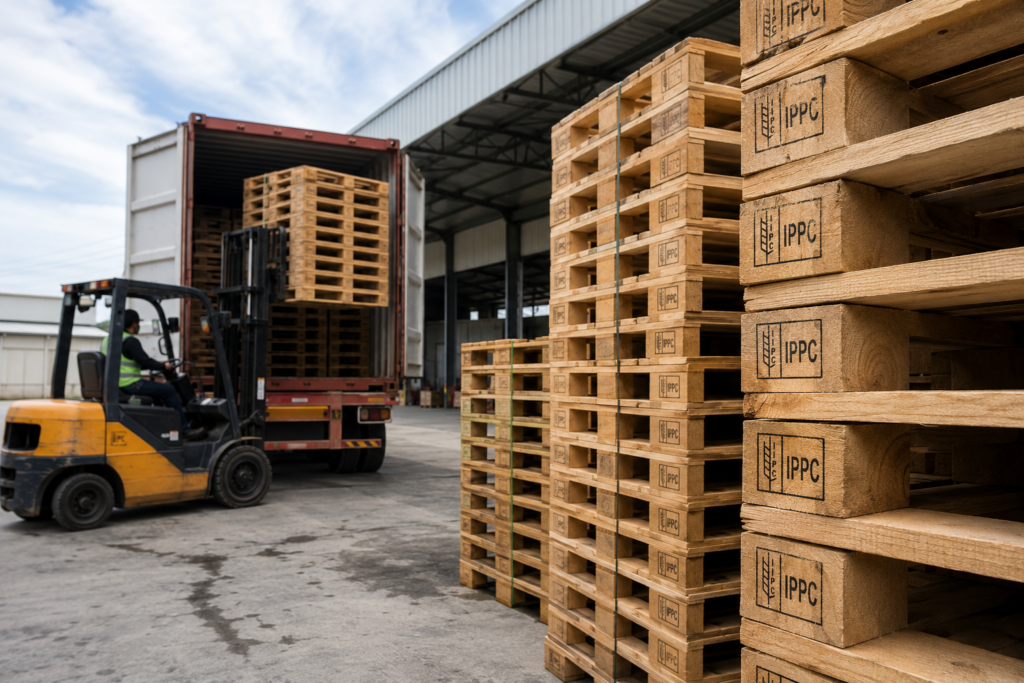
Common export industries include:
- Manufacturing
- Agriculture
- Food processing
- Industrial equipment
- Forestry products
- Building materials
Using compliant pallets before products leave your warehouse helps avoid customs delays, rejected shipments, and unnecessary replacement costs.
Domestic Shipping Is Different
For shipments moving within Canada, standard wooden pallets are commonly used without ISPM 15 treatment, provided the pallets meet the operational requirements of the shipment.
However, businesses shipping both domestically and internationally often standardise part of their pallet inventory to simplify warehouse operations and avoid confusion during order fulfilment.
Export Tip: Export compliance should be confirmed before products are packed, not after a trailer has been loaded. Verifying pallet requirements early can prevent delays, repacking costs, and missed shipping deadlines.
Hardwood vs. Softwood Pallets: Does the Material Matter?
When discussing standard pallet specifications, dimensions are only part of the equation. The type of lumber used to manufacture a pallet also influences durability, weight, repairability, and overall performance.
In Canada, most wooden pallets are manufactured using either hardwood or softwood, with the choice depending on product requirements, availability, and intended use rather than one material being universally better than the other.
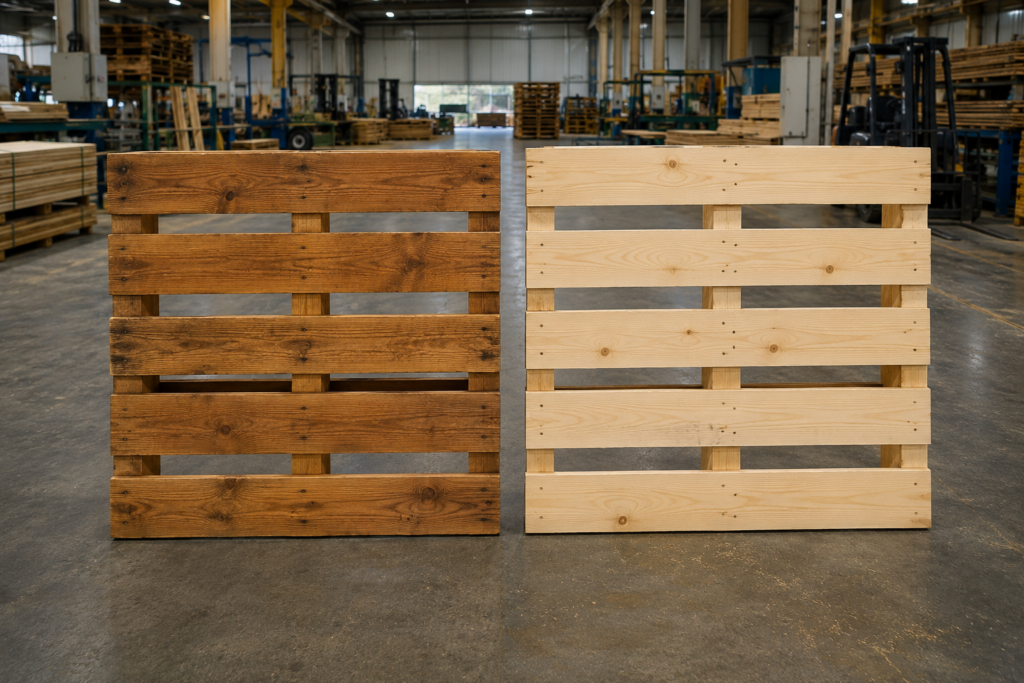
Hardwood Pallets
Hardwood species such as oak and maple are often selected for demanding applications where strength and durability are priorities.
They are commonly used for:
- Heavy industrial products
- Machinery
- Metal components
- Long-term warehouse storage
- High-load applications
Because hardwood is denser, these pallets generally offer greater durability but may also weigh more than comparable softwood designs.
Softwood Pallets
Softwood pallets are typically manufactured from species such as pine or spruce. They are widely used throughout warehousing and distribution because they provide a practical balance between strength, weight, and cost.
Typical applications include:
- Consumer goods
- Retail distribution
- Food packaging
- Manufacturing
- General logistics
Their lighter weight can also contribute to easier manual handling and transportation efficiency in many operations.
Which Material Should You Choose?
There isn’t a single answer for every business.
Instead, consider:
- Product weight
- Shipping frequency
- Storage environment
- Export requirements
- Budget
- Expected pallet lifespan
Selecting the right material is about supporting your products safely while achieving the best long-term operational value, not simply choosing the strongest wood available.
Warehouse Insight: Many businesses focus on pallet dimensions while overlooking the importance of material selection. In reality, the right combination of pallet size, construction, and lumber species has a much greater impact on long-term performance than any one factor on its own.
Common Mistakes Businesses Make When Choosing a Standard Pallet
Ordering a pallet based solely on its dimensions can lead to avoidable handling problems, damaged products, and higher operating costs. While the standard pallet size works for many applications, it’s only one part of selecting the right pallet for your business.
Avoiding these common mistakes can improve warehouse efficiency and help pallets perform as intended throughout their service life.
Buying Based on Size Alone
The 48 × 40 pallet is widely used, but that doesn’t automatically make it the best option for every product. Load weight, product dimensions, and handling requirements should always be considered alongside pallet size.
Ignoring Construction Type
Two pallets with identical dimensions may perform differently depending on whether they’re built as block or stringer pallets. Matching the construction to your handling equipment and workflow is just as important as choosing the correct footprint.
Forgetting About Export Requirements
Businesses preparing international shipments sometimes focus on pallet dimensions while overlooking ISPM 15 compliance. Verifying export requirements before shipping helps prevent delays and unnecessary costs.
Overlooking Product Overhang
When products extend beyond the edges of a pallet, they become more vulnerable to impact during handling and transportation. In some situations, a purpose-built pallet provides better product protection than forcing oversized goods onto a standard footprint.
Choosing the Lowest Price Instead of the Best Value
The least expensive pallet isn’t always the most economical over time. Durability, repairability, handling efficiency, and suitability for the application all contribute to the total value a pallet delivers throughout its service life.
Expert Advice: The best pallet decision is rarely based on one specification. Businesses achieve better long-term results by evaluating dimensions, construction, material, handling methods, and shipping requirements together rather than in isolation.
Choosing the Right Standard Pallet Starts with Understanding Your Operation
The standard pallet size of 48 × 40 inches remains the most widely used option across Canadian supply chains because it offers the right balance of storage efficiency, transportation compatibility, and everyday handling. However, the best pallet isn’t always the standard one—it should match your product dimensions, load requirements, warehouse systems, and shipping destination.
If your operation requires a specialised solution, exploring custom pallets may improve load stability and reduce handling challenges. Businesses shipping internationally should also ensure they use heat-treated pallets that comply with export requirements. Understanding these factors helps you select pallets that support both operational efficiency and long-term performance.